


Sports Betting Margin: Why It Matters for South Africans


Placing a wager on your favourite Premier League clash often feels like testing your instincts and knowledge, but there is a hidden factor shaping your real chance of success. The concept of sports betting margins lies at the heart of every bet, subtly influencing the odds and your potential profit. For South African sports bettors determined to secure the best value, understanding how bookmakers use the overround to guarantee profit is essential. This guide reveals how different margin types impact your returns so you can make smarter choices on every match.
Table of Contents
- Defining Sports Betting Margin And Key Concepts
- Types Of Betting Margins And Common Variations
- How Bookmakers Calculate Their Margin
- South African Regulations On Margins And Odds
- How Margins Affect Your Winnings And Value
- Avoiding Common Mistakes And Maximising Returns
Key Takeaways
| Point | Details |
|---|---|
| Understanding Betting Margins | Sports betting margins represent the built-in profit mechanism for bookmakers, essential for South African punters to make informed wagering decisions. |
| Types of Betting Margins | Different betting types have varying margin structures, influencing potential returns; punters should recognise this diversity for strategic betting. |
| Regulatory Oversight | South African regulations aim to protect consumers by ensuring fair margin practices, promoting transparency in the betting industry. |
| Maximising Returns | To improve betting outcomes, punters should focus on calculating implied probabilities and practising effective bankroll management. |
Defining sports betting margin and key concepts
Understanding sports betting margins is crucial for South African punters seeking to make informed wagering decisions. A betting margin represents the built-in profit mechanism bookmakers use to ensure financial sustainability across various sporting events. This mechanism allows betting platforms to generate revenue regardless of the match outcome.
At its core, the sports betting margin (also known as the overround) is a mathematical calculation that determines bookmaker profit margins. Here’s how it fundamentally works:
- The bookmaker sets odds that collectively sum to more than 100%
- This percentage above 100% represents their potential profit margin
- Different sporting events and bet types can have varying margin percentages
- Margins are typically higher on less predictable or more complex betting markets
Bookmakers strategically adjust these margins to balance their potential risk and reward. For South African sports bettors, understanding these margins can help you:
- Identify more favourable betting opportunities
- Compare different bookmaker offerings
- Calculate potential returns more accurately
- Make more informed betting decisions
The mathematics behind betting margins might seem complex, but it essentially ensures that bookmakers maintain a statistical advantage. Decimal odds are particularly useful in calculating these margins, as they provide a straightforward method for understanding potential returns.
Betting margins are the invisible mechanism that transforms sports wagering from a pure chance activity into a calculated business model.
Pro tip: Always compare the implied margins across different bookmakers to find the most competitive odds and maximise your potential returns.
Types of betting margins and common variations
Sports betting margins manifest in various forms across different types of wagers, each with unique characteristics that influence potential returns for South African punters. Betting types significantly impact margin structures, creating diverse opportunities and challenges for strategic bettors.
The primary types of betting margins include:
- Moneyline margins: Fixed percentage applied to straightforward win/lose bets
- Point spread margins: Variable margins based on predicted team performance differences
- Totals (over/under) margins: Calculated on predicted total points or scores
- Parlay margins: Compounded margins that increase with multiple bet combinations
- Proposition (prop) bet margins: Often higher margins due to increased unpredictability
Each margin type operates differently, reflecting the complexity and risk associated with specific betting markets. For instance, moneyline bets typically have lower margins compared to more speculative prop bets, which carry higher bookmaker risk.
Here is a comparison of the main sports betting margin types and their typical risk levels for punters:
| Margin Type | Typical Margin Percentage | Risk for Punters |
|---|---|---|
| Moneyline | Low to moderate (3-7%) | Low to moderate risk |
| Point Spread | Moderate (5-10%) | Variable risk |
| Totals (Over/Under) | Moderate (5-10%) | Moderate risk |
| Parlay | High (10% and above) | Very high risk |
| Proposition Bet | Very high (10-20%+) | Highest risk |
Bookmakers adjust these margins dynamically based on several crucial factors:
- Historical team performance
- Current player fitness and availability
- Market liquidity and betting volume
- Perceived probability of specific outcomes
Sophisticated bettors understand that margin variations represent more than mathematical calculations – they’re strategic tools for managing risk and potential returns.
Pro tip: Always calculate the implied probability behind the odds to determine whether a particular betting margin offers genuine value.
How bookmakers calculate their margin
Bookmakers employ sophisticated mathematical techniques to calculate their betting margins, ensuring profitability across various sporting events. Bookmakers strategically adjust odds to guarantee profit by manipulating the implied probability of different outcomes.
The core calculation of a betting margin involves several key mathematical principles:
- Decimal odds conversion: Converting odds into implied probabilities
- Overround calculation: Summing probabilities to exceed 100%
- Risk distribution: Balancing potential payouts across different scenarios
- Market adjustment: Dynamic odds modification based on betting patterns
- Probability manipulation: Slightly reducing true event probabilities
The mathematical process typically follows these fundamental steps:
- Determine the true probability of each potential outcome
- Adjust probabilities to create a built-in profit margin
- Convert adjusted probabilities back into decimal odds
- Ensure total implied probabilities exceed 100%
For South African punters, understanding this process reveals how bookmakers consistently maintain an advantage. The margin is essentially the difference between the true mathematical probability and the odds offered to bettors.
Bookmaking is a precise science where mathematics trumps chance, guaranteeing long-term profitability through strategic probability management.
Pro tip: Learn to calculate the implied probability behind odds to identify betting opportunities with genuine value.

South African regulations on margins and odds
Sports betting regulations in South Africa play a critical role in protecting consumers and maintaining industry integrity, particularly concerning betting margins and odds. National gambling regulations directly influence betting practices to ensure fair and transparent operations across the gambling landscape.
The key regulatory mechanisms governing sports betting margins include:
- Licensing requirements: Strict operational standards for betting platforms
- Transparency mandates: Ensuring clear communication of odds and potential returns
- Consumer protection protocols: Preventing exploitative margin practices
- Reporting obligations: Regular disclosure of betting market performance
- Independent oversight: Continuous monitoring by national gambling authorities
The National Gambling Board of South Africa maintains rigorous standards to prevent unfair betting practices:
- Verify bookmaker margin calculations
- Ensure odds reflect reasonable market probabilities
- Monitor for potential market manipulation
- Investigate complaints regarding betting margin practices
- Enforce penalties for non-compliant operators
These regulations aim to balance bookmaker profitability with consumer protection, creating a controlled environment that prevents excessive margin exploitation while maintaining a sustainable betting ecosystem.
Regulatory oversight transforms sports betting from a potentially risky activity into a structured, accountable marketplace.
Pro tip: Always verify a bookmaker’s licensing status and regulatory compliance before placing any bets.
How margins affect your winnings and value
Betting margins are the invisible mechanism that directly impacts a punter’s potential returns, creating a structural advantage for bookmakers. Gambling industry statistics reveal significant financial implications for South African bettors who do not understand margin mechanics.
The fundamental ways margins affect winnings include:
- Reduced potential returns: Lower payouts compared to true probability
- Long-term value erosion: Consistent marginal losses over multiple bets
- Implied probability distortion: Odds that do not reflect actual event likelihood
- Risk premium embedding: Additional bookmaker profit built into each wager
- Compounded mathematical disadvantage: Increasing losses with more frequent betting
Mathematically, betting margins work against punters through several critical mechanisms:
- Converting true probabilities into less favourable odds
- Generating automatic profit for bookmakers
- Creating a statistical buffer against player winnings
- Adjusting payouts to ensure consistent bookmaker revenue
- Minimising potential player advantage
South African bettors must understand that margins represent more than simple mathematical calculations. They are sophisticated risk management tools designed to ensure bookmaker profitability across diverse betting scenarios.
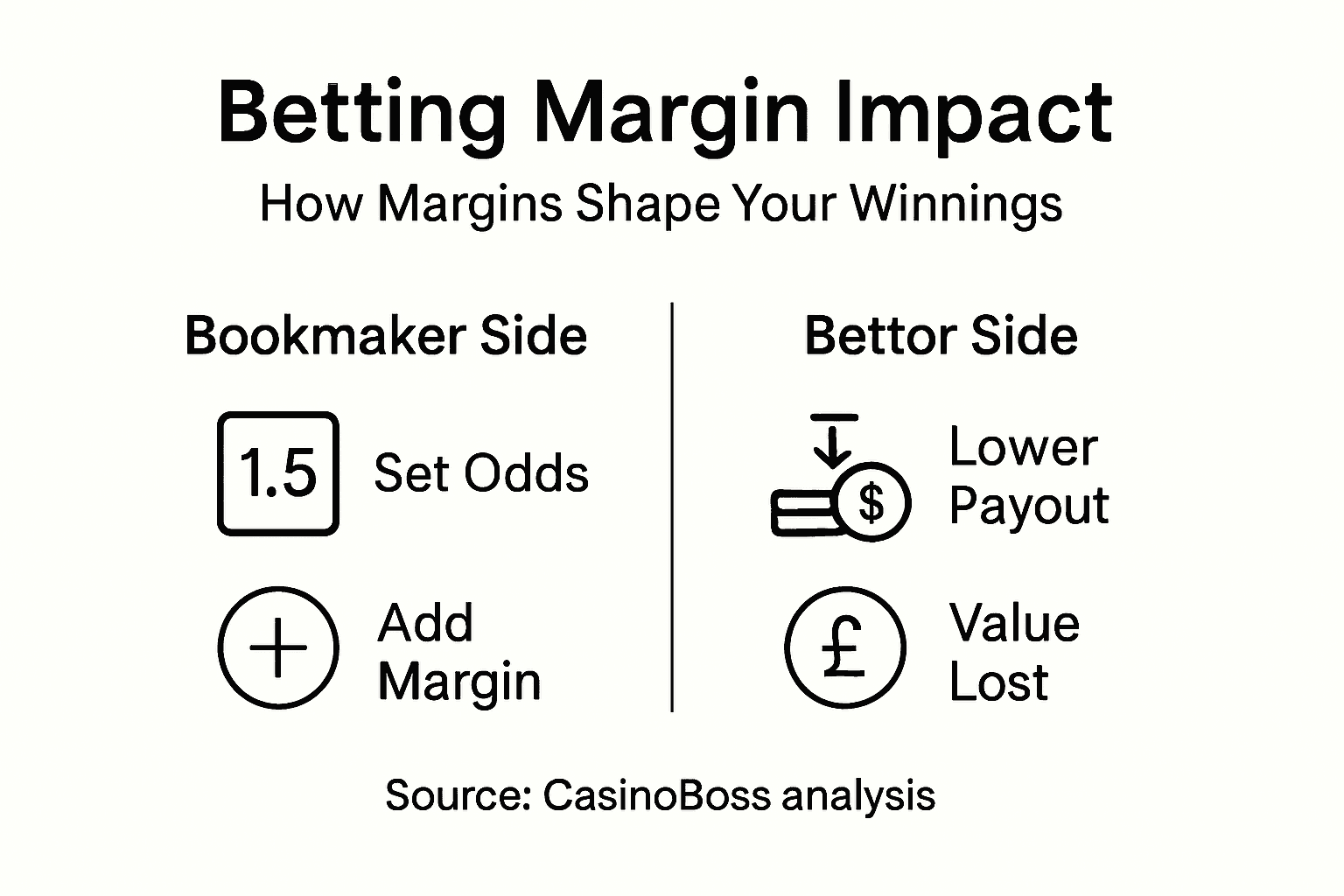
The following table summarises common bookmaker margin impacts for South African punters:
| Margin Impact | Effect on Punters | How to Counteract |
|---|---|---|
| Reduced payout | Lower winnings | Shop for better odds |
| Value erosion | Less profit over time | Use implied probability |
| Compounded disadvantage | Higher long-term losses | Limit frequent betting |
| Implied probabilities gap | Misleading odds displayed | Compare multiple bookmakers |
Every bet contains an inherent mathematical challenge where the bookmaker’s margin acts as an invisible tax on potential winnings.
Pro tip: Calculate the implied probability behind odds to understand the true value of your potential bet.
Avoiding common mistakes and maximising returns
Successful sports betting requires a strategic approach that goes beyond intuition, with punters needing to understand and counteract inherent bookmaker advantages. Optimal betting strategies demand sophisticated probability management to minimise losses and maximise potential returns.
Common mistakes South African bettors frequently encounter include:
- Emotional betting: Making decisions based on feelings rather than data
- Chasing losses: Increasing stakes to recover previous unsuccessful bets
- Ignoring value: Failing to calculate true probability versus bookmaker odds
- Inadequate bankroll management: Inconsistent or reckless stake allocation
- Overconfidence: Believing personal knowledge trumps statistical probability
Strategic approaches to improve betting performance involve:
- Developing a consistent, disciplined betting strategy
- Understanding and calculating implied probabilities
- Managing bankroll with predetermined stake sizes
- Maintaining detailed betting records
- Regularly reviewing and adjusting betting approach
Professional bettors recognise that long-term success depends on understanding mathematical principles and maintaining emotional control, rather than relying on sporadic lucky wins.
Successful betting is a marathon of calculated decisions, not a sprint of random chances.
Pro tip: Implement the Kelly criterion for calculating optimal bet sizes to balance potential returns with risk management.
Master the Art of Beating Betting Margins with Expert Guidance
Navigating the complexities of sports betting margins can feel overwhelming, especially when you want to maximise your returns and avoid hidden disadvantages. This article highlights critical challenges such as understanding implied probabilities and the varied margin types that South African punters face daily. Recognising how bookmakers calculate their margins and how these affect your winnings is the first step towards making smarter, more profitable bets.

Ready to take control of your sports betting journey? Visit CasinoBoss for comprehensive reviews and expert advice tailored specifically to South African players. Discover top-rated, licensed platforms with transparent odds, strategic insights on market value, and effective bankroll management tips that empower you to outsmart bookmaker margins. Don’t let invisible margins erode your winnings — start maximising your potential today by exploring our trusted betting guides at CasinoBoss.co.za. Your smarter bet begins here.
Frequently Asked Questions
What is a sports betting margin?
A sports betting margin is the built-in profit mechanism that bookmakers use to ensure their financial sustainability across various sporting events. It represents the percentage that the odds sum to over 100%, indicating the bookmaker’s profit potential.
How do betting margins affect my potential returns?
Betting margins reduce your potential returns by providing odds that are typically lower than the true probabilities of outcomes. This creates a statistical advantage for bookmakers and can lead to long-term losses if not understood.
What types of betting margins are there?
There are several types of betting margins, including moneyline margins, point spread margins, totals (over/under) margins, parlay margins, and proposition bet margins. Each has different characteristics affecting risk and potential returns for bettors.
How can I calculate the implied probability behind betting odds?
To calculate the implied probability, convert the decimal odds into a percentage using the formula: Implied Probability = 1 / Decimal Odds. This calculation helps you understand whether the odds offered provide genuine value compared to the true likelihood of an outcome.
Recommended

