


SA Gambling Law: What It Means for Online Players


Finding your way through South African gambling laws can feel like trying to solve a puzzle with missing pieces. With the National Gambling Act of 2004 setting national standards and each province creating its own rules, it is no wonder myths and misinformation trip up so many players. Understanding the real difference between land-based and online gambling—and why most online platforms are not legally licensed in South Africa—empowers you to make safe choices and avoid risky, unregulated sites.
Table of Contents
- Defining SA Gambling Law And Common Myths
- Legal Gambling Types In South Africa
- How Regulation And Licensing Work Nationwide
- Requirements For Operators And Player Safeguards
- Risks, Penalties, And Protecting Yourself
Key Takeaways
| Point | Details |
|---|---|
| Legal Gambling Framework | South Africa’s gambling regulation consists of both national and provincial laws, creating a complex landscape for players. |
| Online Gambling Restrictions | Online gambling is generally prohibited, and players should only engage with licensed, regulated operators for safety. |
| Identifying Licensed Operators | Always verify the operator’s provincial gambling licence to ensure legality and player protection. |
| Risks of Unlicensed Platforms | Playing on unlicensed platforms poses significant risks, including legal penalties and financial loss. |
Defining SA gambling law and common myths
South Africa’s gambling regulation isn’t one simple set of rules—it’s a multi-layered framework that trips up many players. The National Gambling Act of 2004 forms the foundation, but the story gets complicated quickly because nine provinces each have their own legislation running alongside national rules.
The confusion starts here: gambling itself simply means staking money on an unknown outcome with the hope of winning value. That covers everything from lottery tickets to online casino games. But South Africa’s laws treat different types of gambling very differently, and that’s where myths flourish.
Provincial versus National Control
Picture this: the national authority sets baseline standards, but your province can impose stricter rules or different requirements. It’s like having two bosses in the same office, sometimes pulling in different directions.
Each of South Africa’s nine provinces operates under both national law and its own provincial gambling regulations. This dual-authority system creates confusion because what’s permitted in one province might be restricted in another.
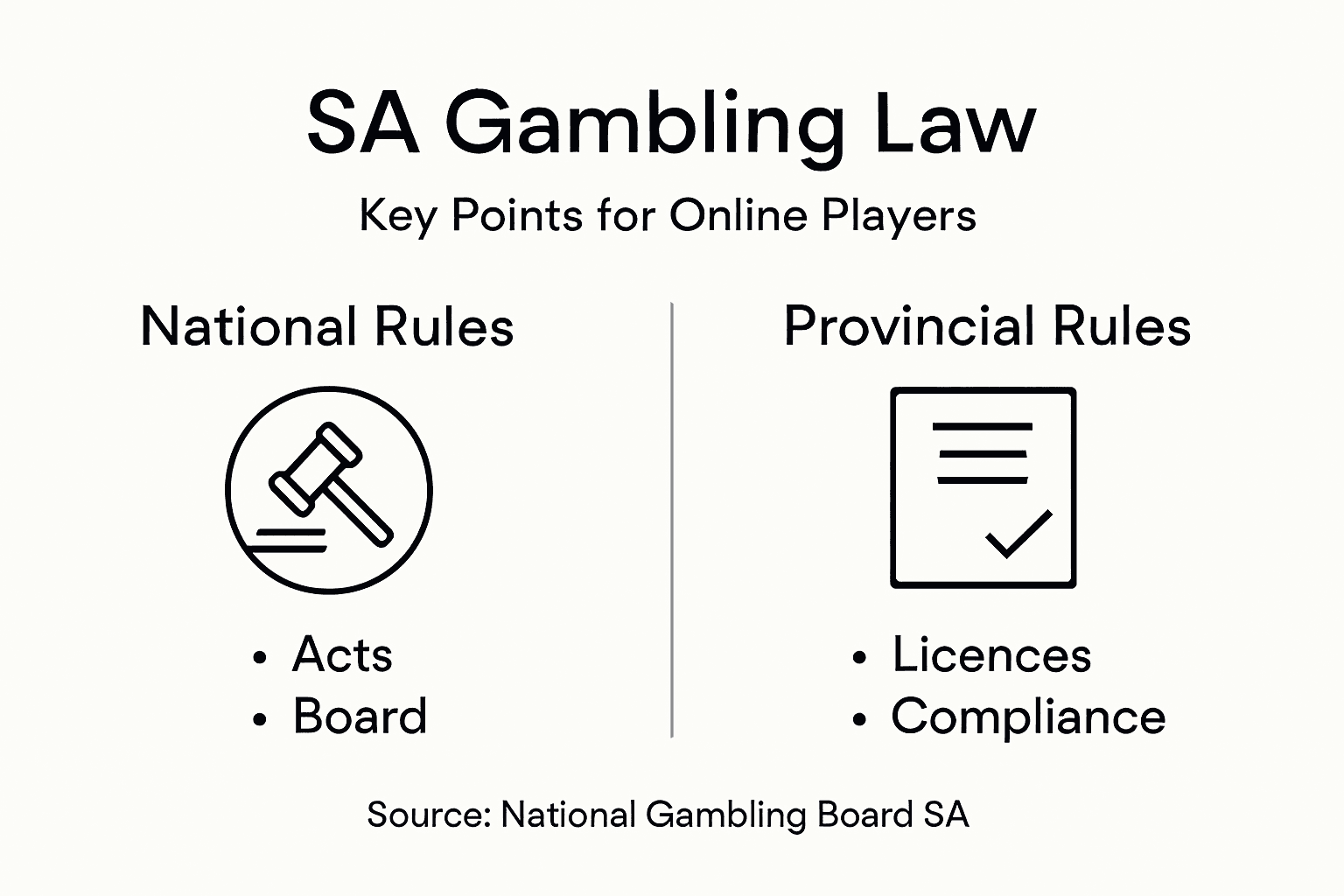
The National Gambling Board oversees the broader framework, whilst provincial gambling boards handle licencing and compliance within their borders. This split responsibility is the source of most myths players encounter.
The Online Gambling Reality
Here’s where clarity matters most: online gambling remains generally prohibited in South Africa under current legislation. This single fact contradicts what many players believe about their legal options.
Many players assume that because online casinos operate and accept South African players, they’re legal and regulated locally. They’re not. The law treats online gambling differently from land-based casinos, which hold proper provincial licences.
The prohibition exists because:
- No national online gambling licence framework currently exists
- Provinces haven’t established separate online betting regulations
- The original 2004 legislation predates modern online betting
- Control and consumer protection remain difficult to enforce across borders
Common Myths Debunked
Myth one: “If an online casino accepts South African players, it’s legal to use.” False. Acceptance and legality are entirely different. Many unlicensed operators actively target South African players without holding any local authority approval.
Myth two: “Online betting is completely illegal, so I should avoid it entirely.” Partially true but oversimplified. The legal status is grey, not black and white. Many international operators with legitimate overseas licences operate in South Africa without explicit prohibition against individual players—though the platforms themselves break South African law.
Myth three: “Sports betting online is always illegal.” Not entirely accurate. Some sports betting platforms operate under specific regulatory exemptions or grey-area interpretations, though this remains contested.
Myth four: “Land-based casinos and online gambling have the same legal status.” Completely wrong. Land-based casinos hold provincial licences and operate legally. Online platforms generally don’t hold South African licences, creating a fundamental legal difference.
The core issue: South Africa’s gambling laws haven’t fully adapted to online betting. This legal gap is exactly where confusion thrives and where players get caught between competing interpretations of the law.
Why These Myths Matter to You
Understanding the actual legal framework protects you in several ways. When you know which platforms operate legally versus illegally, you can identify which ones have genuine regulatory oversight and player protections.
Illegal operators often refuse to pay winnings, vanish with deposits, or exploit weak security. Legal, licensed platforms answer to provincial authorities and must maintain standards for fairness and fund protection.
Your best defence is knowing that what makes online casinos legitimate involves proper licensing from recognised authorities—something most online platforms operating in South Africa simply don’t have.
Pro tip: Always verify whether an online platform holds a legitimate South African provincial gambling licence or operates under a recognised international regulatory authority before depositing money—this single check eliminates most fraudulent operators and illegal services.
Legal gambling types in South Africa
Not all gambling is illegal in South Africa—far from it. The law permits several specific gambling activities, each with its own licensing requirements and regulatory framework. Understanding which types are legal protects you from fraud and ensures you’re playing on properly regulated platforms.
South Africa’s legal gambling landscape divides into two clear categories: land-based gambling and online gambling. Land-based activities include casinos, sports betting, and lotteries. Online gambling remains largely restricted, creating confusion about what you can legally access from your computer or mobile phone.
The following table clarifies key differences between land-based and online gambling legality in South Africa:
| Aspect | Land-Based Gambling | Online Gambling |
|---|---|---|
| Legal Status | Fully legal with licence | Generally prohibited |
| Regulator | Provincial gambling board | No national regulatory body |
| Player Protections | Strictly enforced measures | Mostly lacking or inconsistent |
| Licence Requirement | Mandatory, by province | Rare, highly restricted |
Legal Land-Based Gambling Activities
Land-based gambling in South Africa includes several established forms:
- Casino gaming – slots and table games at licensed venues
- Sports betting – wagering on football, rugby, horse racing, and other sporting events
- Horse racing – specialised betting on equestrian events
- Lotteries – national and provincial lottery draws
- Bingo – licensed bingo halls and venues
- Poker – in licensed establishments
Each type requires a provincial licence from the relevant gambling authority. Only licensed operators can legally offer these services. This licensing system means players have recourse if something goes wrong—they can complain to the provincial gambling board.
Online Gambling: The Grey Zone
Online gambling operates under different rules. Most legal gambling types in South Africa don’t have established online frameworks. The National Gambling Board hasn’t created a comprehensive online betting licence system, leaving the space largely prohibited.
However, this doesn’t mean nothing is legal online. Some provinces have granted limited online betting licences to specific bookmakers. These exceptions remain rare and highly restricted compared to land-based options.

The prohibition exists to protect players from unlicensed operators who can vanish with deposits, refuse payouts, or exploit security weaknesses. Without proper licensing, there’s no regulator to hold them accountable.
Social Gaming and Skill Games
Social gambling without monetary prizes remains legal. Games of pure skill without prize money also escape prohibition. Think friendly poker nights where nobody’s risking real money, or video games where the only stakes are bragging rights.
The distinction matters: if money changes hands, licensing becomes mandatory. If it doesn’t, the activity sits outside gambling law entirely.
Legal gambling in South Africa requires either a provincial land-based licence or a specific exemption—anything outside these categories operates in a legal grey zone or is prohibited outright.
Why Licensed Platforms Matter
Licensed operators must meet strict standards. They maintain independent audits, fund segregation accounts for player protection, and employ responsible gambling measures. Their licences can be revoked if they violate regulations.
Unlicensed platforms answer to no authority. They can operate without audits, refuse to pay winners, or close overnight without explanation. The difference between playing at a licensed venue and an unlicensed one is the difference between having legal protection and having none.
Understanding why online gambling carries risks helps you recognise legitimate operators versus fraudulent ones.
Pro tip: Before playing anywhere online, verify the operator holds a valid provincial South African gambling licence or operates under a recognised international regulatory authority—this single check eliminates most illegal and fraudulent platforms.
How regulation and licensing work nationwide
South Africa’s gambling regulation operates through a two-tier system that separates national oversight from provincial control. Understanding this structure helps you identify legitimate operators and avoid unlicensed platforms that prey on confused players.
The National Gambling Act of 2004 established the framework, but day-to-day licensing and enforcement happen at provincial level. This division creates both protection and complexity—protection because multiple authorities oversee standards, complexity because rules vary by province.
National Level: Setting the Standards
The National Gambling Board sits at the top of the regulatory pyramid. It doesn’t issue licences directly to casinos or betting shops. Instead, it sets minimum standards and ensures provinces follow them.
The National Gambling Board’s responsibilities include:
- Establishing norms and standards for all gambling operations
- Overseeing provincial board compliance with national rules
- Ensuring consistent enforcement across all nine provinces
- Developing policy on new gambling issues and disputes
- Protecting consumers through uniform requirements
Think of the National Gambling Board as the rule-maker. Provinces are the enforcers.
Provincial Level: Where Licencing Happens
Each of South Africa’s nine provinces operates its own gambling board. These boards issue the actual licences that allow casinos, betting shops, and lotteries to operate. A licence granted in one province doesn’t automatically work in another.
Provincial boards review applications, conduct background checks on operators, and monitor compliance. They can revoke licences if operators break rules or endanger player protection.
This means a legitimate operator needs separate licences for each province where it wants to operate. A national casino chain must hold nine separate provincial licences. This layering makes fraud harder because every provincial board independently verifies the operator.
The Licensing Process
Operators don’t just fill out a form and get approved. The licensing process requires strict compliance with multiple criteria:
- Proof of financial stability and capitalization
- Background checks on owners and managers
- Detailed security and player protection plans
- Independent audit and testing agreements
- Demonstration of responsible gambling measures
- Proof of proper fund segregation for player deposits
Provincial boards can take months to review applications. They reject applications that fail security checks or lack financial transparency.
Ongoing Compliance and Audits
Getting a licence is just the start. Licensed operators must maintain compliance continuously. Provincial boards conduct regular audits, often unannounced. Independent testing agencies verify game fairness through mathematical audits.
Operators must file regular reports on revenue, player complaints, and responsible gambling measures. Failure to comply can result in suspension or licence revocation. This ongoing oversight protects players—unlicensed operators have none of this scrutiny.
Legitimate gambling regulation requires coordination between national standards and provincial enforcement—anything operating outside this two-tier system lacks the oversight that protects your money and winnings.
Why This Matters for Online Players
Online operators claiming to serve South Africa should hold provincial gambling licences. If they don’t mention a specific provincial licence or claim exemptions you’ve never heard of, they’re likely unlicensed.
Unlicensed operators face no audits, no compliance checks, and no consequences for refusing payouts. They’re essentially gambling with your money in an unregulated environment where the house always wins because nobody’s watching.
Pro tip: Always request an operator’s provincial gambling licence number and verify it directly with the relevant provincial gambling board before depositing money—this confirms they’re legitimate and regulated, not operating illegally.
Requirements for operators and player safeguards
Licensed gambling operators in South Africa must meet stringent requirements designed to protect players and maintain industry integrity. These standards separate legitimate businesses from fraudulent platforms that operate without oversight or accountability.
Operators face a demanding licensing process before they can legally accept a single bet. This isn’t bureaucratic red tape—it’s the foundation that keeps your money safe and ensures games are fair.
What Operators Must Do
Licensed operators must comply with multiple regulatory requirements:
- Obtain provincial gambling licences through rigorous application processes
- Demonstrate financial stability and adequate capitalisation
- Pass thorough background checks on all owners and senior managers
- Implement technical standards for game fairness and security
- Maintain transparent operational procedures
- Comply with strict anti-money laundering protocols
- File regular compliance reports to provincial authorities
- Submit to ongoing audits and inspections
These aren’t optional guidelines. Operators who fail to meet any requirement face licence suspension or revocation.
Player Safeguards Built Into Law
South African law mandates specific player protections through responsible gambling measures. Operators must actively protect players, not just avoid obvious harm.
Mandatory safeguards include:
- Self-exclusion programmes allowing players to ban themselves temporarily or permanently
- Betting limits on deposits, stakes, and losses
- Age verification systems preventing underage gambling
- Addiction detection tools identifying problem gambling patterns
- Public education campaigns about gambling risks
- Clear terms and conditions showing deposit protection methods
- Dispute resolution processes for player complaints
Operators must fund these programmes themselves. They can’t cut corners to save money—regulators audit these safeguards regularly.
Anti-Money Laundering Compliance
Operators must implement robust anti-money laundering systems. This protects both the industry and players by preventing criminal networks from using gambling platforms to launder illegal funds.
Compliance includes customer identity verification, transaction monitoring, and reporting suspicious activity to authorities. These measures might feel intrusive, but they’re essential for industry legitimacy.
Financial Protection for Players
Licensed operators must maintain segregated player funds. Your deposit sits in a separate account, isolated from the operator’s business account. If the operator fails financially, your money remains protected because it’s not part of their assets.
Unlicensed operators can’t offer this protection. Your deposit becomes their operating capital, disappearing if they close or go bankrupt.
Legitimate operators are required to protect player money, limit harmful betting, and identify addiction—requirements that cost them money but keep you safe.
Identifying Operators Who Skip Requirements
Operators avoiding these requirements are red flags. No regulated operator will claim these safeguards are “unnecessary” or “optional.” If a platform refuses to show its licence, lacks self-exclusion tools, or won’t verify your age, it’s operating illegally.
Many unlicensed operators deliberately avoid these requirements because compliance costs money. They’d rather cut corners and risk regulatory action than spend on proper player protection infrastructure.
Pro tip: Verify that any operator you use publicly displays its provincial licence number, explains its self-exclusion process, and allows you to set deposit limits—these three things signal compliance with South African player protection laws.
Risks, penalties, and protecting yourself
Playing on unlicensed gambling platforms carries real consequences—both legal and financial. South Africa’s government actively prosecutes illegal gambling operators and players who knowingly use them, treating it as a serious offence with substantial penalties.
Understanding these risks helps you make informed decisions about where to gamble. The difference between licensed and unlicensed platforms isn’t just about fairness; it’s about your legal exposure and financial safety.
The Risks of Unlicensed Gambling
Unlawful gambling poses significant risks that go beyond losing money on unfair games. These risks include:
- Financial fraud and deposit theft by unscrupulous operators
- Unfair gaming where odds are rigged against you
- Problem gambling without protective safeguards or limits
- Identity theft from poor security standards
- Money laundering schemes that implicate you legally
- No recourse when disputes arise or funds vanish
Unlicensed platforms operate without oversight. They can refuse payouts, close overnight, or sell your data to criminals. You have zero legal protection.
Legal Penalties for Players
South Africa’s National Gambling Act prohibits unlawful gambling. Players who knowingly use unlicensed platforms face serious criminal penalties. These aren’t minor fines.
Penalties include:
- Substantial fines running into thousands of Rands
- Imprisonment for repeated or large-scale violations
- Criminal records affecting employment and reputation
- Asset seizure if authorities suspect money laundering
- Liability for facilitating illegal gambling operations
Whilst enforcement primarily targets operators, players who deliberately use illegal platforms aren’t automatically protected from prosecution, especially if they’re knowingly participating in an illegal scheme.
How Operators Get Caught
Law enforcement agencies actively collaborate with financial institutions, banking regulators, and provincial gambling boards to identify and shut down illegal operations. Many players think they’re anonymous online. They’re not.
Operators get caught through:
- Financial tracking showing suspicious transactions
- Player complaints leading to investigations
- Regulatory sweeps targeting illegal marketing
- Intelligence sharing between authorities
- Banking system alerts for gambling-related activity
When an operator gets shut down, player information often becomes evidence. This exposure can create legal complications for you.
Protecting Yourself: The Essential Steps
Your best protection is simple: use only licensed operators. Verify every platform before depositing money. Don’t assume an operator is legitimate because it accepts South African players—many illegal operators actively target South African customers.
Protection checklist:
- Request the operator’s provincial gambling licence number
- Verify the licence directly with the provincial gambling board
- Check whether they display self-exclusion and deposit limit tools
- Confirm they use segregated player fund accounts
- Review their responsible gambling policies
- Confirm their anti-money laundering compliance procedures
- Test their customer support before depositing money
Playing on unlicensed platforms exposes you to fraud, legal penalties, and financial loss—none of which exist when you use licensed operators.
Red Flags That Signal Illegal Operation
Certain warning signs indicate an operator is operating illegally. If you see any of these, stop immediately and don’t deposit money:
- Refusal to display a provincial licence number
- Unclear or constantly changing terms and conditions
- No self-exclusion or deposit limit options
- Aggressive marketing targeting problem gamblers
- Promises of guaranteed wins or “impossible” odds
- Pressure to deposit large amounts quickly
- Difficulty withdrawing winnings or repeated delays
- No legitimate customer support contact information
These red flags appear specifically because illegal operators skip regulatory requirements that legitimate operators must follow.
Here is a reference table outlining signs of legal versus illegal gambling operators in South Africa:
| Indicator | Legal Operator | Illegal Operator |
|---|---|---|
| Licence Displayed | Always visible with licence number | Often missing or hidden |
| Player Fund Segregation | Kept in independent accounts | Mixed with business funds |
| Responsible Gambling Tools | Provided and regularly audited | Absent or non-functional |
| Dispute Resolution | Formal, via regulator | Non-existent or ignored |
Pro tip: Before depositing anything, phone the relevant provincial gambling board directly and confirm the operator’s licence status—this five-minute phone call eliminates almost all risk of using an illegal platform.
Stay Safe and Informed with Trusted South African Gambling Resources
Navigating the complex landscape of South African gambling law can feel overwhelming, especially when distinguishing legal operators from unlicensed platforms that put your money and security at risk. At Casinoboss.co.za, we understand your need for clarity when it comes to licensed provincial gambling boards, player safeguards, and the legal grey areas surrounding online betting.

Discover expertly curated reviews and comparisons of online casinos and sports betting sites that comply fully with South African regulations. From game variety to secure payment options, Casinoboss offers you essential guidance to avoid illegal operators and protect yourself against fraud and legal penalties. Take the first step to safer online gambling by exploring our Blackjack Video Tips Archives – casinoboss and comprehensive casino reviews at Casinoboss.co.za. Empower your betting experience today with trusted insights and make every wager count.
Frequently Asked Questions
What types of gambling are legal in South Africa?
The legal forms of gambling in South Africa include land-based casino gaming, sports betting, horse racing, lotteries, bingo, and poker, all of which require provincial licensing. Online gambling remains largely prohibited.
Is online gambling legal in South Africa?
Online gambling is generally prohibited in South Africa as there is no national licensing framework for it, and most operators targeting South African players do not hold local licences.
How can I identify a legitimate online gambling operator?
To identify a legitimate online gambling operator, check for a valid provincial gambling licence number, ensure they provide self-exclusion mechanisms and deposit limits, and verify that they use segregated player funds to protect your money.
What are the risks of using unlicensed online gambling platforms?
Using unlicensed online gambling platforms can lead to significant risks, including financial fraud, unfair gaming, lack of player protection, and potential legal penalties for participating in unlawful gambling activities.
Recommended

