


Why Use Betting Strategies – Boosting Success Safely


Placing a bet in South Africa can feel like a guessing game without a proper plan. Many new players discover that betting strategies offer more than just luck, guiding decisions and managing risk for safer, more consistent results. Understanding how these structured approaches work means learning to choose reliable platforms and avoid common financial mistakes, helping you turn casual gambling into smarter, more disciplined play.
Table of Contents
- What Betting Strategies Really Mean
- Popular Strategy Types And Their Uses
- How Strategies Reduce Risk And Losses
- Legal And Responsible Betting Practices
- Common Mistakes And Long-Term Pitfalls
Key Takeaways
| Point | Details |
|---|---|
| Understand Betting Strategies | Structured approaches help manage risk and maximise returns, transforming gambling from chance to informed decision-making. |
| Implement Risk Management | Strategies like Bankroll Management and Emotional Control are essential for minimising losses and ensuring long-term sustainability. |
| Avoid Common Mistakes | Recognise pitfalls such as Chasing Losses and Overconfidence, which can lead to significant financial decline. |
| Engage in Responsible Gambling | Comply with legal regulations and utilise available support resources to create a safe betting environment. |
What Betting Strategies Really Mean
Betting strategies represent structured approaches designed to manage risk and maximise potential returns when gambling. These methodical frameworks go far beyond random guesswork, providing systematic techniques that help bettors make more calculated decisions across sports betting and casino gaming environments.
At their core, betting strategies are analytical models that help players:
- Manage financial risk more effectively
- Reduce emotional decision-making
- Establish consistent wagering patterns
- Understand probability and potential outcomes
- Control betting expenditure
Understanding these strategies requires recognising that successful betting isn’t about winning every single wager, but about creating sustainable long-term approaches. Betting strategy frameworks provide mathematical and psychological tools that transform gambling from pure chance into a more predictable activity.
Most betting strategies fall into several fundamental categories, each with unique principles and applications. Some focus on mathematical probability, while others emphasise psychological discipline and bankroll management. By implementing these structured approaches, bettors can significantly improve their chances of maintaining financial stability while enjoying gambling entertainment.
Pro tip: Always treat betting strategies as risk management tools, not guaranteed winning methods.
Popular Strategy Types and Their Uses
Betting strategies are not one-size-fits-all approaches but rather nuanced techniques tailored to different gambling scenarios and individual player preferences. Common betting strategies offer diverse methods for managing risk and maximising potential returns across various gambling platforms.
The most prevalent betting strategies include:
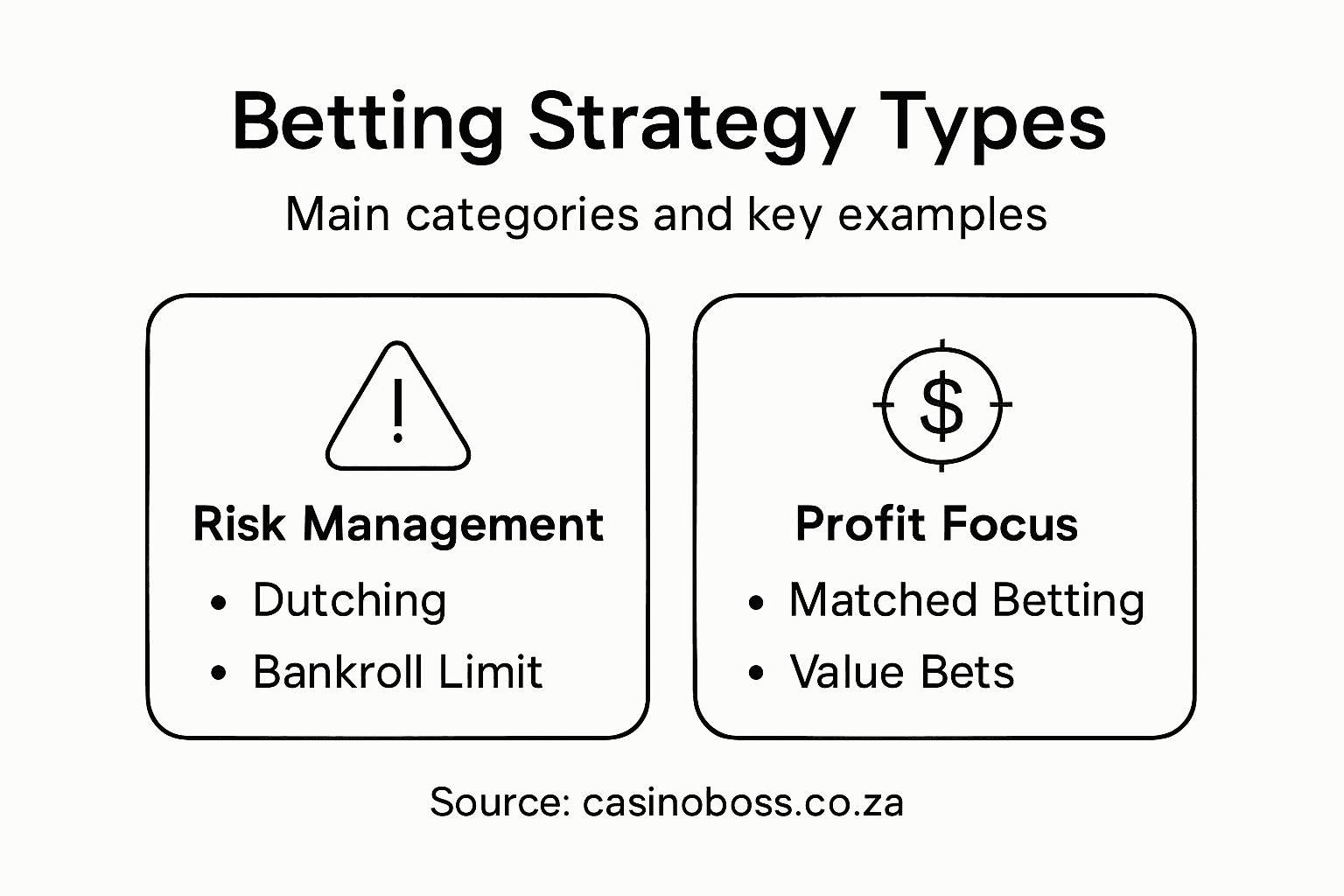
- Dutching: Spreading stakes across multiple selections to guarantee a potential return
- Matched Betting: Leveraging bookmaker promotions by placing opposing bets
- Level Staking: Maintaining a consistent betting amount regardless of odds
- Value Betting: Identifying wagers with positive expected mathematical returns
- Martingale Strategy: Progressively increasing bet sizes after losses
Each strategy serves a unique purpose in a bettor’s toolkit. Dutching helps reduce overall risk by distributing potential losses, while matched betting allows players to extract value from promotional offers without significant gambling exposure. Level staking provides consistent financial discipline, preventing impulsive high-risk wagers.
Here’s a comparison of popular betting strategy types and their core advantages:
| Strategy Type | Primary Benefit | Analytical Complexity |
|---|---|---|
| Dutching | Increased return certainty | Moderate |
| Matched Betting | Exploits bookmaker offers | High |
| Level Staking | Maintains financial discipline | Low |
| Value Betting | Finds underestimated odds | Very High |
| Martingale | Recovers losses progressively | Low |
Value betting represents perhaps the most sophisticated approach, requiring deep analytical skills to identify opportunities where bookmaker odds underestimate true probabilities. This strategy demands extensive research, statistical analysis, and a comprehensive understanding of sporting dynamics and mathematical probability.
Pro tip: Always combine multiple strategies and continuously adapt your approach based on performance data and changing market conditions.
How Strategies Reduce Risk and Losses
Long-term betting strategies are fundamental tools for minimising financial risk in gambling environments. These approaches transform betting from pure chance into a more calculated and controlled activity, allowing players to protect their bankroll while maintaining potential for returns.
Key risk reduction strategies include:
- Bankroll Management: Setting strict financial limits
- Research-Based Decisions: Gathering comprehensive information before placing bets
- Emotional Control: Preventing impulsive wagering
- Diversification: Spreading risks across multiple betting opportunities
- Consistent Stake Sizing: Maintaining uniform bet amounts
Zero-risk techniques like matched betting provide additional protection by leveraging bookmaker promotions to minimise potential losses. These approaches involve strategic bet placement that essentially guarantees a profit or significantly reduces potential financial exposure.

Successful risk mitigation requires discipline and systematic approach. Bettors must develop a consistent methodology that prioritises long-term sustainability over short-term gains. This involves continuous learning, meticulous record-keeping, and a willingness to adapt strategies based on performance data and changing market conditions.
Pro tip: Implement a strict 1-3% maximum stake rule to protect your overall betting bankroll from significant single-event losses.
Legal and Responsible Betting Practices
National Gambling Board regulations play a crucial role in maintaining ethical standards and player protection within South Africa’s gambling landscape. These comprehensive guidelines ensure that betting platforms operate transparently, prioritising player safety and responsible gambling practices.
Key legal and responsible gambling principles include:
- Age Verification: Strict checks to prevent underage gambling
- Financial Transparency: Clear disclosure of betting terms and conditions
- Self-Exclusion Options: Mechanisms for players to limit their gambling activity
- Problem Gambling Support: Providing resources for addiction prevention
- Fair Gaming Guarantees: Ensuring randomness and preventing manipulation
The South African regulatory framework focuses on balancing economic opportunities with social responsibility. Provincial and national authorities collaborate to implement robust monitoring systems that protect vulnerable individuals while maintaining a regulated betting environment. This approach involves comprehensive licensing processes, ongoing compliance checks, and strict penalties for operators who fail to meet established standards.
Responsible gambling isn’t just about legal compliance; it’s a shared commitment between players, platforms, and regulatory bodies to create a safe, ethical betting ecosystem. Players must actively engage with available support mechanisms, set personal limits, and remain aware of potential gambling-related risks.
Pro tip: Always verify a betting platform’s official licensing before creating an account, and familiarise yourself with their responsible gambling resources.
Common Mistakes and Long-Term Pitfalls
Betting can become a treacherous landscape when players fail to recognise fundamental strategic errors that gradually erode their financial stability. Understanding these common mistakes is crucial for maintaining a sustainable and responsible approach to gambling.
The most significant long-term pitfalls include:
- Chasing Losses: Attempting to recover previous gambling losses through increasingly risky bets
- Emotional Betting: Making impulsive decisions driven by frustration or excitement
- Ignoring Bankroll Management: Failing to set and maintain strict financial limits
- Overconfidence: Believing past successes guarantee future winning streaks
- Lack of Research: Placing bets without comprehensive understanding of odds and conditions
Psychological traps represent perhaps the most insidious long-term risks in betting. Many players develop cognitive biases that distort their perception of probability and potential outcomes. The gambler’s fallacy – believing that past events influence future random results – can lead to catastrophic decision-making and sustained financial losses.
Overview of common psychological betting errors and their potential impacts:
| Mistake Type | Typical Trigger | Long-Term Consequence |
|---|---|---|
| Chasing Losses | Emotional frustration | Rapid bankroll depletion |
| Overconfidence | Recent wins | Unwise high-risk bets |
| Lack of Research | Impatience | Poor value decisions |
| Gambler’s Fallacy | Misunderstanding odds | False winning expectations |
| Ignoring Discipline | Stress or boredom | Uncontrolled spending |
Successful bettors recognise that gambling is fundamentally a mathematical probability game. Consistent success requires emotional detachment, disciplined strategy, and a willingness to accept occasional losses as part of a broader statistical approach. Developing a systematic, research-driven mindset is the most effective defence against these pervasive betting pitfalls.
Pro tip: Maintain a detailed betting journal to track your performance, identify patterns, and objectively analyse your long-term betting behaviour.
Elevate Your Betting Strategy with Expert Guidance and Safe Choices
Understanding the importance of structured betting strategies is the first step towards confident and sustainable gambling. If you want to manage your bankroll wisely, avoid common pitfalls like chasing losses, and apply techniques such as matched betting or value betting, then relying on trusted information and reputable platforms is crucial. At Casinoboss.co.za, we help South African players navigate these challenges by providing detailed reviews, safety insights, and practical strategy tips designed to boost your long-term success.

Explore our Blackjack Video Tips Archives – casinoboss for rewarding advice or visit our main site at Casinoboss.co.za to find top-rated, fully licensed platforms that prioritise responsible gambling. Take control today and start betting smarter with expert guidance tailored to your needs.
Frequently Asked Questions
What are betting strategies and why are they important?
Betting strategies are structured approaches designed to manage risk and maximise potential returns when gambling. They help bettors make more calculated decisions rather than relying on chance alone, ultimately leading to a more sustainable and informed approach to betting.
How do betting strategies reduce financial risk while gambling?
Betting strategies reduce financial risk by promoting disciplined bankroll management, encouraging research-based decision making, and utilising methods to control emotions. They enable players to develop consistent wagering habits and protect their bankroll over the long term.
What are some popular types of betting strategies?
Popular betting strategies include Dutching, which spreads stakes across multiple selections; Matched Betting, which exploits bookmaker promotions; Level Staking, which maintains consistent stake sizes; Value Betting, which identifies favourable odds; and the Martingale Strategy, which progressively increases bets after losses.
How can I avoid common mistakes when using betting strategies?
To avoid common mistakes, always set strict financial limits, avoid chasing losses, and refrain from making impulsive decisions based on emotions. Conduct thorough research before placing bets and maintain a detailed betting journal to track your performance and identify patterns.
Recommended

