


Explaining Betting Odds: Smarter Sports Wagering Decisions


Placing your first sports bet in South Africa can feel confusing when you see numbers like 2.50 or 5/1 next to your favorite team’s name. Learning what these odds mean is the foundation for making smarter choices and confidently managing your wagers. By understanding the differences between Decimal, Fractional, and American odds formats, you unlock the language that reveals potential payouts and helps spot real betting value. With clear guidance, you can avoid common mistakes and start betting with purpose.
Table of Contents
- Defining Betting Odds And Key Terms
- Types Of Odds Used In South Africa
- How Betting Odds Calculate Your Winnings
- Spotting Favorites, Underdogs, And Value
- Common Mistakes And Safe Betting Tips
Key Takeaways
| Point | Details |
|---|---|
| Understanding Betting Odds | Familiarize yourself with American, Decimal, and Fractional formats, as each presents the same probabilities differently. |
| Identifying Value Bets | Learn to assess team performance, injuries, and historical data to uncover value opportunities that exceed market odds. |
| Avoiding Common Mistakes | Steer clear of emotional betting and chase losses; prioritize thorough research to make informed decisions. |
| Bankroll Management | Implement strict financial limits and view betting as entertainment, which helps maintain discipline in wagering. |
Defining Betting Odds and Key Terms
Betting odds represent the mathematical probability of an event occurring in sports wagering, providing crucial information about potential payouts and underlying risks. These numerical representations tell bettors exactly how much they might win relative to their initial stake, functioning as a critical language of sports gambling. Understanding betting odds requires familiarity with three primary formats: American, Decimal, and Fractional.
In the American odds format, positive numbers (like +150) indicate potential profit on a 100 dollar bet, while negative numbers (like -150) show how much you must wager to win 100 dollars. Decimal odds display the total potential return, including your original stake, with 2.50 meaning a 150 dollar return on a 100 dollar bet. Fractional odds represent profit relative to the stake – so 5/1 means winning 500 dollars for every 100 dollars wagered.
Each odds format communicates risk and potential reward differently, but they all share a fundamental purpose: translating the probability of sporting outcomes into actionable betting information. Sportsbooks build a profit margin called vig or juice into these odds, ensuring they maintain an advantage regardless of the event’s result. Professional bettors learn to calculate implied probabilities, comparing the stated odds against their own assessment of an event’s likelihood.
Pro tip: Always convert odds between formats and calculate the implied probability to make more informed betting decisions and identify potential value bets.
Types of Odds Used in South Africa
In South Africa, sports betting enthusiasts encounter multiple odds formats that help them calculate potential winnings and understand betting probabilities. Betting odds formats primarily include Decimal, Fractional, and American styles, each offering unique ways of representing potential returns and risks.
The Decimal Odds format dominates the South African sports betting landscape, offering straightforward calculations where the number represents the total potential return, including the original stake. For instance, odds of 2.50 mean a 100 dollar bet would return 250 dollars (100 dollars stake plus 150 dollars profit). Fractional Odds, more common in the United Kingdom but still recognized in South Africa, display potential profit relative to the stake – such as 5/2, which means winning 250 dollars on a 100 dollar bet.
American Odds remain less prevalent in South African markets but are still understood by experienced bettors. Positive numbers like +150 indicate potential profit on a 100 dollar bet, while negative numbers like -150 show how much must be wagered to win 100 dollars. South African bookmakers carefully adjust these odds based on team performance, market demand, and internal risk assessments, creating a dynamic betting environment that requires strategic analysis.
Pro tip: Always compare odds across multiple bookmakers to identify the most favorable betting opportunities and maximize potential returns.
Here’s a quick comparison of betting odds formats and how they calculate winnings:
| Odds Format | How Winnings Are Calculated | South Africa Prevalence | Example Calculation |
|---|---|---|---|
| Decimal | Stake x decimal odds | Most common | $100 x 2.50 = $250 return |
| Fractional | (Stake x fraction) + stake | Moderate | $100 on 5/2 = $350 return |
| American (+/-) | Varies by sign, convert as needed | Least common | +150: $100 wins $150 profit |
How Betting Odds Calculate Your Winnings
Understanding how to calculate potential winnings is crucial for making informed sports betting decisions. Calculating betting winnings involves different methods depending on the specific odds format you are using. Each format provides a unique approach to determining your potential return, requiring bettors to understand the mathematical nuances behind their wagers.
With Decimal Odds, the calculation is straightforward – simply multiply your stake by the decimal number to determine your total potential return. For example, a 100 dollar bet at odds of 2.50 would return 250 dollars, which includes your original stake plus 150 dollars in profit. Fractional Odds work differently, where you multiply your stake by the fractional number and then add your original stake. A 5/2 bet means for every 2 dollars wagered, you win 5 dollars, plus your original stake.

American Odds introduce additional complexity, with positive and negative numbers representing different scenarios. Positive odds (like +150) indicate how much profit you would make on a 100 dollar bet, while negative odds (like -150) show how much you must bet to win 100 dollars. Professional bettors learn to quickly convert between these formats, understanding that each represents the same underlying probability but displays it through different mathematical lenses.
Pro tip: Practice converting between different odds formats using online calculators to build your computational skills and improve your betting strategy.
Spotting Favorites, Underdogs, and Value
Successful sports betting requires more than simply backing the favorite or picking random underdogs. Value betting strategies involve sophisticated analysis of market dynamics, team performance, and probability assessments that go far beyond surface-level predictions. Understanding how to identify genuine value opportunities separates professional bettors from casual gamblers.
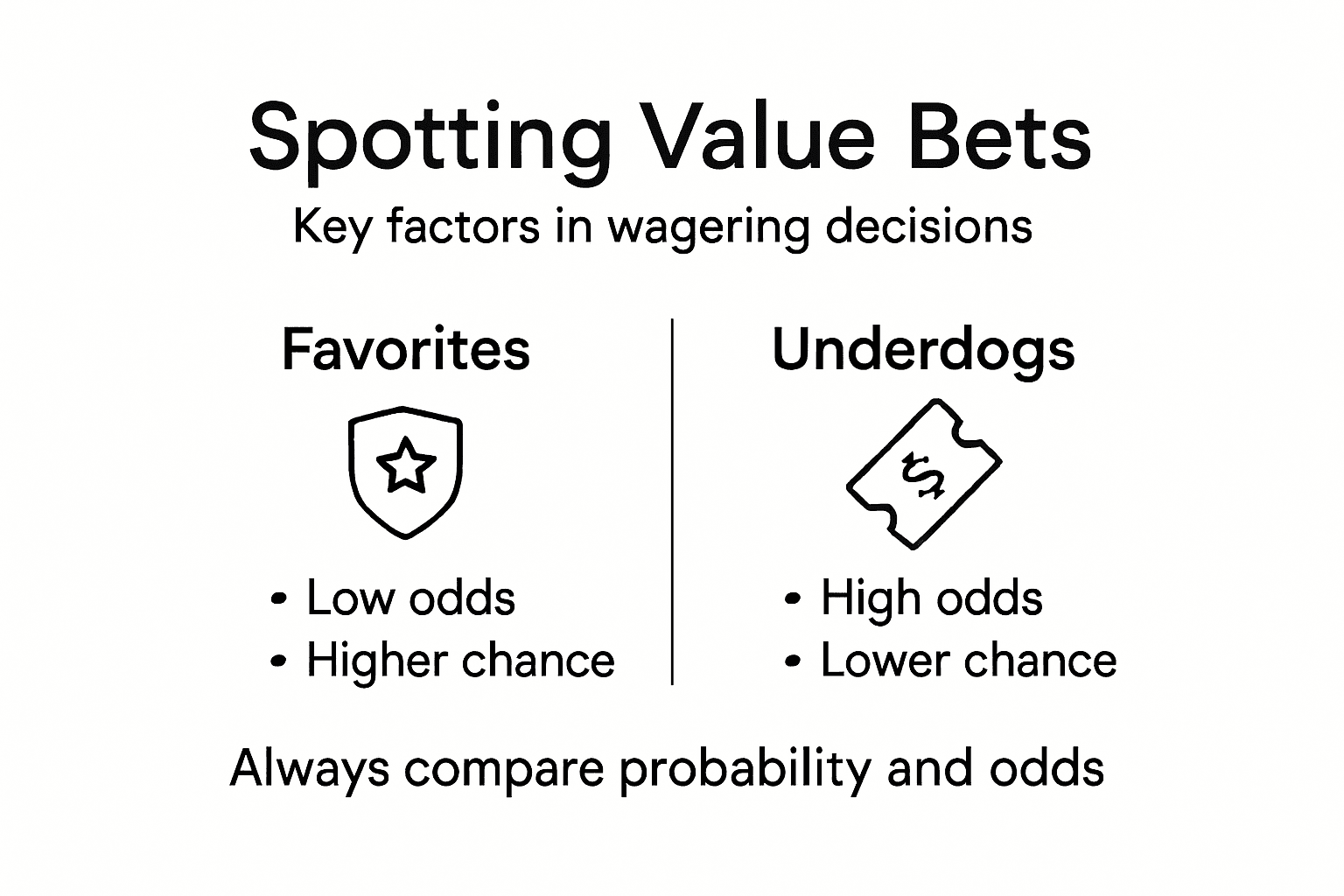
Favorites are typically represented by lower odds, indicating a higher probability of winning, but they do not always guarantee profitable returns. Underdogs, with higher odds, present unique opportunities when their actual chances of winning are underestimated by bookmakers. Experienced South African bettors look for value bets – situations where the potential payout significantly exceeds the perceived risk. This involves comparing the bookmaker’s implied probability against your own carefully researched assessment of the likely outcome.
Critical factors in spotting value include recent team performance, head-to-head historical records, player injuries, home field advantage, and situational motivations that might not be immediately reflected in standard odds. Professional bettors develop nuanced evaluation skills, learning to recognize when public sentiment or bookmaker adjustments create statistical inefficiencies that can be strategically exploited. The key is maintaining objectivity and avoiding emotional decision-making, instead relying on systematic, data-driven analysis.
Below is a summary of factors used to identify value bets in sports wagering:
| Factor | Impact on Value Assessment | Professional Betting Use |
|---|---|---|
| Team Performance | Reveals current strengths | Guides match predictions |
| Historical Records | Shows team matchup trends | Identifies hidden advantages |
| Player Injuries | Affects outcome probabilities | Triggers odds re-evaluation |
| Home Field Advantage | Increases team win chances | Used for adjusted calculations |
Pro tip: Develop a consistent methodology for comparing your calculated probability against bookmaker odds, tracking your accuracy to refine your value betting approach over time.
Common Mistakes and Safe Betting Tips
Successful sports betting requires more than luck – it demands strategic thinking and disciplined approach. Common betting mistakes can quickly erode your bankroll and transform an enjoyable activity into a financial liability. Understanding these pitfalls is the first step toward responsible and potentially profitable sports wagering.
One of the most critical errors South African bettors make is emotional betting – placing wagers based on feelings, personal bias, or momentary excitement rather than rational analysis. This often leads to chasing losses, where bettors attempt to recover previous defeats by making increasingly risky bets. Proper bankroll management is essential, which means establishing strict financial limits, never betting more than you can afford to lose, and treating sports betting as a form of entertainment rather than a guaranteed income source.
Another significant mistake involves failing to conduct thorough research before placing bets. Professional bettors invest substantial time analyzing team statistics, player performance, historical matchups, and current form. They understand that informed decisions based on comprehensive data are far more likely to yield positive results than random guesses or gut feelings. Additionally, bettors should be cautious about promotional offers and bonuses, carefully reading terms and understanding wagering requirements before accepting any incentives.
Pro tip: Create a detailed betting journal to track your wagers, analyze your decision-making process, and identify patterns in your betting performance.
Master Betting Odds and Elevate Your Sports Wagering
Does decoding betting odds sometimes feel overwhelming? The intricate details about Decimal, Fractional, and American odds in this article highlight how crucial it is to understand these terms to make smarter sports betting decisions. Avoid the common pitfalls of emotional betting and vague calculations by equipping yourself with expert insights and trusted resources.

Discover how to translate odds into winning strategies by exploring comprehensive guides and top-rated betting platforms at Casinoboss.co.za. Unlock valuable tips and expert advice that can help you spot real value bets and manage your bankroll responsibly. Start your journey today by browsing our Blackjack Video Tips Archives – casinoboss for strategies that sharpen your gameplay and improve your betting acumen. Don’t wait to boost your confidence and optimize your betting success with reliable, secure online gambling options designed for South African players.
Frequently Asked Questions
What are betting odds and why are they important?
Betting odds represent the mathematical probability of an event occurring and provide crucial information about potential payouts and associated risks in sports wagering. Understanding odds helps bettors make informed decisions on their wagers.
How do I calculate my potential winnings using different odds formats?
To calculate winnings, multiply your stake by the odds format: for Decimal odds, it’s stake x odds; for Fractional odds, it’s (stake x fraction) + stake; and for American odds, positive numbers indicate potential profit on a $100 bet, while negative numbers show how much you must wager to win $100.
What is the difference between favorites and underdogs in sports betting?
Favorites are teams with lower odds, indicating a higher likelihood of winning, while underdogs have higher odds, suggesting they are less likely to win but can present potential value bets when their chances are underestimated by bookmakers.
How can I spot value bets in sports wagering?
To identify value bets, compare the bookmaker’s implied probability against your own assessment of the event. Key factors include team performance, historical records, player injuries, and home field advantage, which can help reveal discrepancies that can be strategically exploited.
Recommended

